
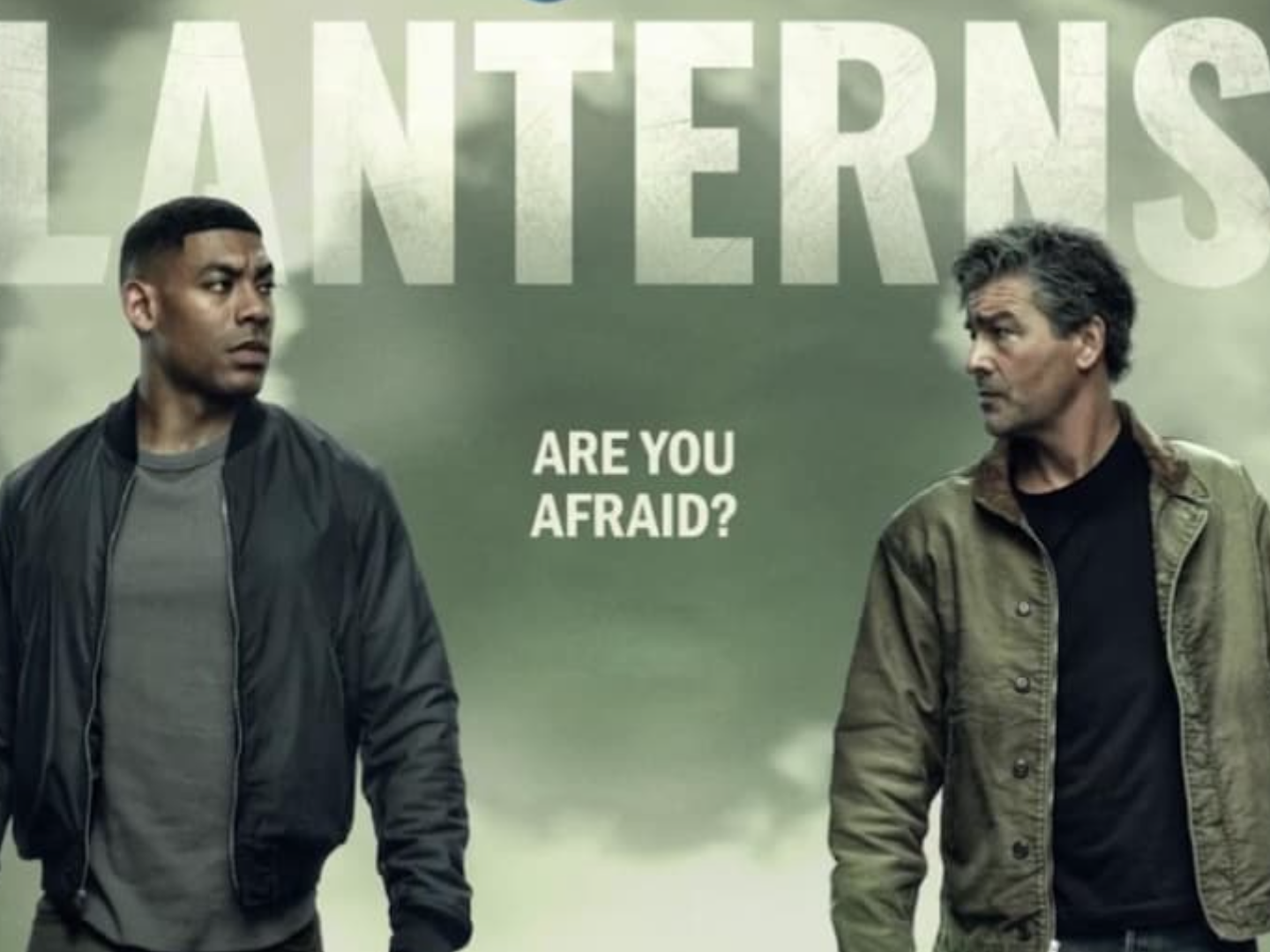
Episode 3 of Lanterns Reclaims the Uncorrupted Meaning of “Woke”: Black Protection and Black Progress
I promise: this essay contains no spoilers. I will only suggest that you watch Episodes 1 and 2 before watching Episode 3, so that what happens in that episode can land in your heart and mind with its full meaning and power.
As I watch the current use of the word “woke,” I am struck by how far it has traveled from the meaning I first understood in the early 2000s—and from its much earlier expressions in Black political and cultural life. Marcus Garvey, for example, issued his Pan-African call to “Wake up Ethiopia! Wake up Africa!” And in 1938, blues and folk musician Lead Belly (Huddie Ledbetter), speaking in connection with his song about the Scottsboro Boys, urged Black people traveling through Alabama to “stay woke.”
Today, the term is routinely deployed by ideological descendants of the anti-civil-rights and anti-Black-progress coalitions of the 1950s and ’60s. More recently, they have been joined by a younger group of self-described progressives who sometimes find themselves apologizing for, and distancing themselves from, what is a false presentation of “woke” or “wokeism.”
And then there is a large cohort of extraordinarily talented Black journalists—all younger than I am—who rarely correct their White colleagues when the term is used in ways that bear little resemblance to its original meaning. Surely many of them are more knowledgeable than I am about its linguistic and cultural origins. (Where is the New York Times’ John McWhorter when we really need him?)
I can understand people in my 75-plus age group being confused about the Woke phrase. The only reason I became familiar with the contemporary use of “woke” many years ago was that, as a lifelong public-school educator, I remained connected through social media to many of my former students.
And what I encountered as the meaning of “woke” was not that complicated.
Stay awake.
Don’t sleep on dangers intended for you. Study—and, in particular, study your history and the history of America’s racist traditions. Stay alert to current events, especially those forces capable of harming your present existence or restricting your future. Recognize threats. Recognize opportunities. Protect yourself. Prepare yourself. Make progress for yourself and your cultural community.
In essence, as I understood it, being “woke” was a call for Black Protection and Black Progress.
I don’t recall anything about DEI, who could use which bathroom, men playing in the WNBA, or canceling the language of White America. In fact, the “woke” commentaries I encountered were not anti-White at all. They simply were not addressed to White America.
They were positive Black messages, by Black people, addressed to Black people.
Who stole “woke” and then cynically corrupted its meaning is an analysis I will leave to those working in the political, cultural-linguistic, and historiographical arenas.
My primary interest, as always, is educational.
And that brings me to Season 1, Episode 3 of Lanterns.
What the writers, director, and actors accomplish in this episode is to educate a nation about the painful fragility of Black existence—especially for Black boys, who are too often forced to surrender their childhoods much too early because, in the eyes of too much of America, their birth certificates might as well have been stamped:
Dangerous if he survives to adulthood.
In that sense, Episode 3 reclaims and restores what I understood to be the original, unadulterated meaning of being “woke”: a compassionate commitment to Black survival and success.
We All Received “The Talk”
Black boys of my generation received “The Talk” when we reached a certain age and, perhaps more importantly, a certain size.
I remember being told that I could no longer run on the sidewalks of Crown Heights, Brooklyn.
“If you want to run, run in the playground at P.S. 9 or in Prospect Park.”
That rule seemed strange to me, since joyfully running was an essential part of our early-adolescent play world. But I was also given very specific instructions about what to do—and what not to do—if stopped by the police. I was told to carry identification and a dollar or two in my wallet.
Like young people everywhere, however, we were determined to prove that the old folks worried too much.
So one day, walking home from Middle School 294, my friends and I decided to race along Vanderbilt Avenue between Fulton Street and Atlantic Avenue. Our adolescent logic was impeccable: there were mostly factories along that stretch and no pedestrians, so technically, we reasoned, we were not really violating our parents’ prohibition against running on crowded sidewalks.
Halfway up the block, a police car pulled us over.
The officers emerged menacingly, shouting and snarling commands.
Suddenly, “The Talk” was no longer an annoying collection of parental rules.
It was a survival manual.
I immediately reminded my friends: Don’t run.
We put our hands against the wall as directed. Continuing down my mental checklist of instructions, I spoke loudly, clearly, and politely, without turning around or making any sudden movements:
“I am reaching into my pocket to get my wallet and I.D.”
Without turning, I handed my wallet to the officer closest to me. Prominently displayed inside was my Police Athletic League (PAL) membership card.
The atmosphere suddenly changed.
One officer said something to the effect of, “Oh, these are Officer Powell’s kids”—referring to the officer who ran the PAL program at our local police precinct.
They let us go.
We continued our journey to the Brooklyn Public Library—shaken and, needless to say, no longer running.
We also reached an immediate and unanimous agreement:
We were not telling our parents about the incident.
I certainly wasn’t, because I had no desire to stand quietly—which is what children were expected to do in those days—through a long Caribbean-American parental speech titled:
“I thought I told you not to…”
That would have been followed by several versions of “What were you thinking?” Followed by: “Oh, you were not thinking?”
And the lecture would not have ended at home. Neighborhood and church elders, aunts, uncles, grandparents, and godparents would eventually have been informed of our bad-decision deed, requiring us to endure multiple sequels of that original admonition speech.
But there was another childhood lesson in Black protection that I did not understand until years later.
I was a dedicated reader of Ebony and Jet magazines. One month, however, I could not find the latest issue of Jet. And, as my mother undoubtedly hoped, I soon forgot about it. There were too many scooters to build, war games to play, comic books to read, and stickball and skelly games demanding my attention.
Years later, I learned why that issue had disappeared.
It contained the horrific open-casket photograph of Emmett Till.
That next summer, without any explanation to us kids—not required in those days—the Black parents in our neighborhood canceled their children’s trips down South. My mother explained to me years later, when I was in college, that the neighborhood “ban” had been imposed largely to protect Black boys from the possibility of suffering a similarly murderous fate.
That was those parents being protectively “woke.”
Not a political slogan.
Not a partisan insult.
Not a cable-news debating point.
Protection. Awareness. Survival. Preparation. Progress.
And That Is What the Parents in Lanterns Are Trying to Do
The Black parents in Lanterns are trying to protect their Black boys the best way they know how—albeit in heightened and dramatic ways appropriate for television.
The two extraordinary actors, Jasmine Cephas Jones and J. Alphonse Nicholson, are portraying what generations of Black parents before, during, and after my generation have tried to do.
First, get their children safely to adulthood.
Second, make them strong enough to confront unfair and undeserved societal obstacles without allowing those obstacles to define or defeat them.
And finally, help them discover and realize their innate gifts, talents, possibilities, and special calling in life.
That is the essential arc of effective parenting.
And schools can either assist or hinder that work.
I resented then—and still resent today—those portions of my childhood that had to end prematurely. I resented having to think about survival to adulthood as a goal at such a young age. And I hated hearing another warning that sounded grossly unfair to my young ears, but turned out to be painfully true: “You must be twice as good to get a fair chance.” My teenage years seemed to exist between dangerous extremes: Would my life be damaged or ended by a police bullet or arrest, drugs, imprisonment, or the unsolicited violence of another Black or Latino teenager in the neighborhood?
As an educator who spent many years working with teenagers, I know that growing up is hard enough. Young people should not also have to calculate their chances of surviving to adulthood while simultaneously trying to discover who they are. They should be thinking about future careers, occupations, aspirations, and possibilities—not wondering who they might become if they can safely make it to adulthood.
That is one reason we desperately need well-educating, intellectually challenging, emotionally nurturing, and physically safe public-school buildings where Black and Latino young people do not feel hunted—or haunted—by society’s fears of them and low expectations for them.
Parents cannot fight this battle alone.
Public schools must do their part.
They must create safe, secure, and educationally rich learning environments capable of bringing forth the best gifts and talents of children whom too much of society has already decided are unworthy of our best adult efforts.
The Baton Must Be Passed
And speaking of gifts and talents, a personal disclosure:
One of the wonderful young actors in Episode 3 of Lanterns, Lumi Oniyide, is the child of two of my former students. One of those former students—despite all of my shortcomings as a principal—decided to become a principal and is now a great one.
There is something beautifully circular about that for me.
A former principal watches the child of his former students portray, in a powerful work of art, themes that connect directly to the lives of generations of Black children—and to the educational responsibility of those adults entrusted with preparing them for the future.
There is always hope in the positive passing of the baton.
One generation protects, prepares, educates, and encourages the next. And then that generation must do the same for the children coming behind them.
Perhaps that is another way to understand what “stay woke” was always supposed to mean:
Know what came before you.
Know what could be coming for you.
Understand what surrounds you.
Protect what is precious to you.
Prepare an easier path for those who will follow you.
And every day, keep moving forward as the best presentation of yourself.
That is our collective, sacred Woke-Hope.
That is Woke Black Protection.
That is Woke Black Progress.
Ask yourself: “Are You Afraid” of a Positive Black Future?
And that is why I hope Episode 3 of Lanterns, “OutKast,” receives the Emmy recognition—and award—I believe it deserves.
Lanterns, Season 1, Episode 3, “OutKast,” is currently streaming on HBO Max and through the HBO Max Amazon Channel in participating regions.