The 2025 NYC mayoral race taught us professional educators, especially those of us who work in high schools, a great deal about the tremendous amount of civic, historical, political science, and economic illiteracy that exists among our graduates. It also revealed how our current curriculum designs for these social science subjects fail to meet the standard of helping future citizen-voters become critical thinkers in the face of polarization and the purposeful misuse of political vocabulary.
The recent widespread invocation of these two very different political ideologies—often conflated in public discourse—suggests that we must examine how well we are doing as public educators in what has become a less-than-stellar, almost “after-thought” approach to civics education.
A visit (and I have) to any high school in Europe, or to any nation with a parliamentary political system of government, reveals that students (and the citizens) possess a far deeper understanding of the critical differences between political ideologies. This is largely because, in those systems, the ideologies present themselves as distinct political parties with formal representation in the national deliberative body of government.
In these parliamentary systems, the Communist Party and the Democratic Socialist Party (along with others such as the Greens, Christian Democrats, Labour, Conservative, and the growing “Far Right” or neo-Fascist parties) hold very different ideas about how government should function. Yet, from time to time, they may align, disentangle, and then realign with one another to form coalitions around specific issues or bills of importance to their members or principles—but they always maintain their own distinct political identities.
I can imagine my professional education colleagues in places like Germany, England, and Italy cringing when they hear Mr. Mamdani being referred to as both a Democratic Socialist and a Communist in the same sentence—as would members of those European parties, who are often bitterly opposed to each other. And if, after observing the European parliamentary systems, one is still unclear that these two political ideologies are profoundly different, then here’s a final lesson: put a Communist and a Democratic Socialist in a room (it sounds like the opening line of a joke) and offer just one word to start the conversation—“Trotsky”—then watch the sparks fly.
The U.S. Two-Party System and the Weaponization of Political Language
In the United States, with its non-parliamentary two-party dominant system, “political affiliation identification” becomes far less clear. Both of the major parties—the Republican (GOP) and the Democratic (DNC)—embrace a capitalist economic framework, and so political labeling becomes extremely murky. This confusion allows language itself to be weaponized. We often hear the GOP accusing someone like Joe Biden of advancing “left-wing” or “Green Party” policies—claims that, of course, couldn’t be further from the truth. Meanwhile, Republicans rarely describe themselves as pro-wealthy, unrestricted-capitalist, right-wing, or (in some policy areas) neo-fascist—which would, in fact, be more accurate descriptors. They have mastered the art of throwing political shade without ever being properly shaded in return by the DNC.
But here lies the deeper problem: both parties are, in essence, pro-capitalist entities primarily serving the interests of the rich—especially their donors. The difference is that the DNC prefers to practice its politics of economic exploitation with a kinder face and softer language, advocating for safety-net-lite measures such as modest consumer protections, less painfully exploitative labor laws, Social Security, food assistance for the working poor, and healthcare programs like the Affordable Care Act (Obamacare).
Civics Ignorance: The Educational Roots of Political Language Misdirection
Now, in terms of “civics ignorance” I’m not referring here to the Vice-President J.D. Vances or the Congressional Representative Elise Stefaniks of the world. Whether or not one agrees with their political ideologies, they are well-educated individuals—even as they work tirelessly to undermine the very fine university systems that educated them. They were educated intellectually, though not necessarily in the moral or ethical sense of graduating with a compassion-guided compass. Their conflation of these two extremely different political ideologies—Democratic Socialism and Communism—is, in their case, a cynical feigning of ignorance. It is a manipulative, opportunistic strategy designed to exploit the very real and frightening ignorance that is widespread among the American citizenry.
The Vance/Stefanik approach to conflation, then, is deliberately tactical. It differs markedly from that of the low-information or intellectually deficient Americans who genuinely believe that Democratic Socialism and Communism are the same thing. And it is on this latter group that I wish to focus.
Before I proceed, I must (in full disclosure) begin with a professional confession. As a former high school principal, I must ask myself: how did we in the profession—especially high school educators—get this critical history, civics, and political-science learning objectives so profoundly wrong for so many people? We cannot hide behind that tired and useless excuse: “We taught the lesson effectively; the students just didn’t learn it effectively.” Wrong!
As many master teachers know, and as countless school administrators have made clear during post-lesson observation conferences, whenever that excuse appears, openly or subtly, the truth must be stated: there is no space between the successful quality of the lesson’s instructional methods and the successful quality of students learning the conceptual and behavioral objectives of that lesson.
In other words, the students didn’t learn effectively because they weren’t taught effectively. If Americans cannot distinguish between different political systems, the fault lies—at least in large part—with us, the public educators.
The News Media Reports—But Schools Must Teach
The traditional news media has been mildly helpful in obligatorily repeating the “Mr. Mamdani is not a communist” correction phrase in many of its news stories, commentaries, and editorials. But this is not one of those “blame the media” moments. The news media’s primary objective is to report and inform, not to remediate civic illiteracy. The deeper problem lies elsewhere.
The primary work of properly educating Americans to read, interpret, and analytically understand those very news articles is the sole responsibility of K–12 educators. It is a sacred charge that cannot be outsourced, deferred, or delegated to any other institution in the nation.
Who Knew? Stephen A. Smith and Curtis “50 Cent” Jackson, Political Economists!
I knew we were in trouble when Stephen A. Smith and Curtis “50 Cent” Jackson became the explaining voices for capitalism. (There are, of course, many distinguished professional Black political economists available.) Yet, instead of drawing from great intellectual resources such as Eric Williams’s Capitalism and Slavery, Walter Rodney’s How Europe Underdeveloped Africa, or Manning Marable’s How Capitalism Underdeveloped Black America, too many turn to celebrity sound bites for their understanding of complex economic theory and political science power dynamics.
Right Now, American Education Is the Problem, but It Is Also the Solution
There are several cross-curricular corrective actions we as professional educators must take—especially at the high school level, to help our students become discerning civic actors in their future adult voting lives. (In other words: no student should leave high school without knowing these things.)
Moral Foundations:
Students must leave us enriched and ennobled with what I call the Major Moral C’s: Moral Conviction, Moral Consistency, and Moral Courage. This means they must learn not to say, “These are not genocidal acts if my side is inflicting the acts.” Every person on the planet must be fully entitled to enjoy their personhood.
Complexity and Contradiction:
Students must understand that two things—sometimes seemingly contradictory—can be true at the same time. For example, our national immigration system is a mess, but unkind cruelty is neither the best nor the most effective operational policy for fixing bad border policies. The opposite of bad actions is good actions, not more bad actions.
Recognizing Shared Humanity:
Students must understand that there are people beyond our own “tribe” who deserve to live their best lives—those who practice religions different from ours, or hold political, cultural, and social beliefs we may not share. What we all share is our humanity, and that descriptive distinction must always be recognized, honored, and protected.
The Virtue of Learning:
Ignorance must never be proudly proclaimed as a virtue. Learning, and continually wanting to learn more about the world beyond one’s own ideas and convictions, is a virtue every twelfth grader should carry with them as they walk across the graduation stage into their next stage of life.
Critical and Metacognitive Thinking:
We must improve and enhance students’ metacognitive (thinking about their own thinking) and analytical skills, helping them move from the limbic (instinctive, emotional) brain system toward higher-order reasoning when facing societal, political, economic, or social problems. And, more importantly, we must also ask: what should all of us do, as thoughtful and compassionate human beings, when we confront the discomfort that accompanies inevitable change?
For example, importing 7,000 white South Africans into the U.S. won’t solve the so-called “Great White Replacement” anxiety fueling parts of the MAGA movement for two important reasons. First, there’s no guarantee that the younger and future generations of those immigrants won’t become more politically progressive and open-minded on questions of race. Second, demographic trends take on lives of their own; so even if every one of those 7,000 South Africans joined the MAGA movement, that number is far too small to alter the birthrate trajectory that underlies the movement’s existential “white replacement” fear of America’s unstoppable shift toward becoming a majority People of Color nation. No discriminatory immigration restriction, no importation of white populations, and no brutal and cruel mass deportation raids will reverse that trend.
Honest History Education:
We must approach the teaching of history as a historiographical science—beginning with truth and facts as guiding curricular standards and evaluative rubrics, and applying deconstructive, inductive, and deductive reasoning techniques. One of history’s primary objectives is to help students learn from past human mistakes. That critical learning cannot occur if we hide or sugarcoat the egregious human errors of the past.
Honesty in teaching history is essential: slavery happened; Japanese internment camps did exist. Glossing over such atrocities or their long-term effects will not erase them from history—ironically, it will make us more likely to repeat them. Seeing the modern rise of neo-Nazi and far-right movements in Germany, France, and England, one would think that the painful lessons of the 1940s had been learned. Apparently, not.
Early and Intentional Civics Education:
We must begin earlier—well before high school—to take seriously the responsibility of producing a well-informed citizenry through thoughtful, intentional civics curricula.
The reason so many of Mr. Mamdani’s critics (including some college-educated individuals on social media—I’ll spare their alma maters the embarrassment by not naming them) can say things like, “He will turn NYC into a Socialist/Communist city” or “a Muslim city,” is because they don’t understand how government actually works. Some on the right know better, but many others, not politically aligned, sincerely believe these falsehoods.
These misconceptions reveal the deep weakness of our high school civics programs—particularly in explaining the structure, powers, and separation of powers among the U.S., New York State, and New York City governments, as well as the statutory authority of their respective legislative and executive agencies and officeholders. And this doesn’t even touch on the powerful non-governmental centers of influence—labor unions, finance, real estate, and the entertainment industry—that all shape governmental policy in very complex but important ways.
In what warped, make-believe universe can a NYC mayor act independently of these entrenched, well-situated, and powerfully positioned players? One of the first lessons you learn as a principal—and learn again as a superintendent—is that most of the “political power capital” you’re said to possess is actually spent on selling ideas: convincing, encouraging, inspiring, and inviting people to follow your leadership. The myth of the all-powerful civil servant executive is just that—a myth. Anyone who took a good NYC high school civics class (and stayed awake) should know better.
Truth Over Propaganda:
Finally, while every nation’s educational system contains some propagandistic elements, teaching inaccuracies—or outright falsehoods—does not prepare students to build a nation or engage intelligently with a globally interdependent world. There must be intellectual space for pedagogical honesty—a space that does not mirror the North Korean model of indoctrination.
We must teach students to ask: What is capitalism as an economic, political, and social system? What is its real relationship to democracy—and what exactly is democracy? How do we explain the “socialist” quality-of-life programs in some Scandinavian countries that seem to work well for their citizens? How many socialized programs must exist before a democracy becomes “socialist”?
If Nicolás Maduro (President of Venezuela) is a “socialist,” in what ways is he or his government practicing socialism? How is Cuba different from the People’s Republic of China, and how are both different from Russia or Vietnam? High school students shouldn’t have to take (and most won’t) an Advanced Placement history, political science, or economics course to wrestle with these essential questions.
The reason a U.S. senator from Alabama—or any prominent figure—can claim that a NYC mayor could somehow turn the city into a “one-religion” place is that such claims only work as put-downs when a large audience shares that same bigoted ignorance.
If Democracy Is to Survive, Public Education Must Be Its Defender
The essential work of democracy has always begun, and will always begin, in the classroom. Whether that classroom sits in a modest rural schoolhouse or a massive urban high school, it is where a nation teaches its young how to think—not what to think, but how to discern, question, and reason morally.
If we as educators fail to equip our students with the intellectual tools to distinguish truth from falsehood, ideology from principle, and propaganda from evidence, then we should not be surprised when demagogues, entertainment celebrities, and political opportunists step in to do our job for us. Civic ignorance is not a natural condition—it is a curriculum outcome.
It is not the media’s responsibility, nor Hollywood’s, nor the politicians’. It is ours. A core principle of the American public education system is the understanding that democracy cannot defend itself; it must be defended by citizens who are educated enough to recognize when democracy is under attack, and moral enough to act when it is.
If the next generation of American students leaves our classrooms unable to tell the difference between Democratic Socialism and Communism, between populism and proto-fascist demagoguery, between patriotism and ethnonationalism, then the republic itself is at grave risk—not because our students are ignorant, but because we, the professional educators, failed to teach them otherwise.
So yes, right now American education is the problem. But it is also, if we are bold and honest enough to face it, the only solution.

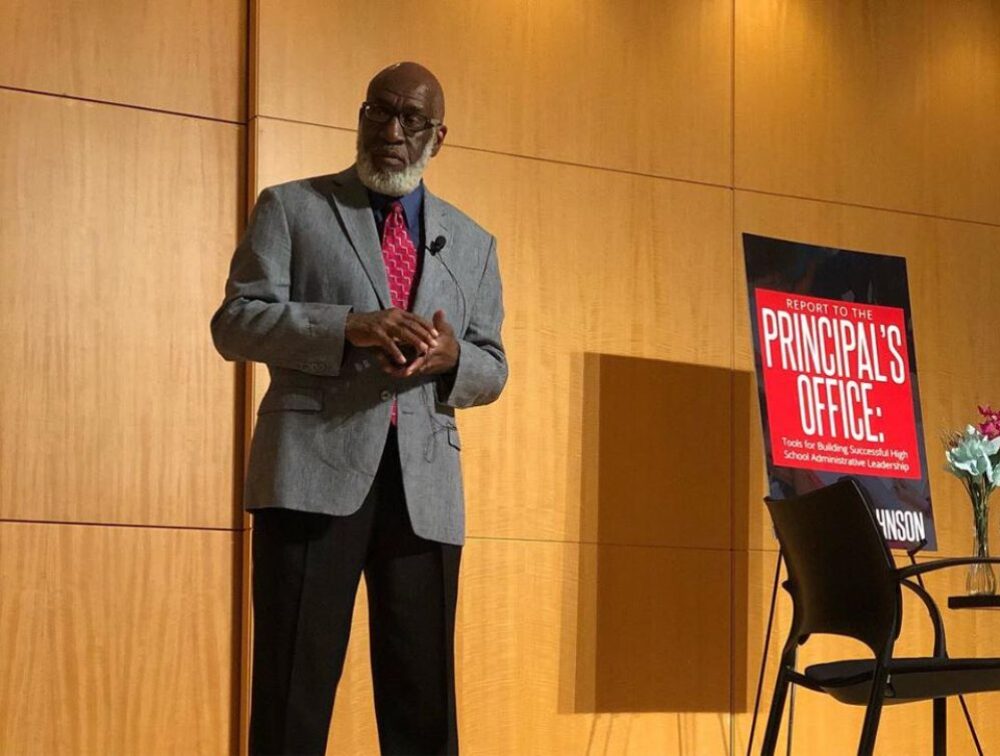
Michael A. Johnson is a former New York City public school teacher, principal, and superintendent (Community School District 29, Queens), a district STEM education program director, and a former adjunct college professor of science education. He is the author of two books on school leadership, designed to prepare the next generation of Assistant Principals and Principals. Johnson writes frequently on educational equity, leadership ethics, and real systemic reform in public education.